Inside the Software Buying Journey: How to Choose the Right Technology Partner in India
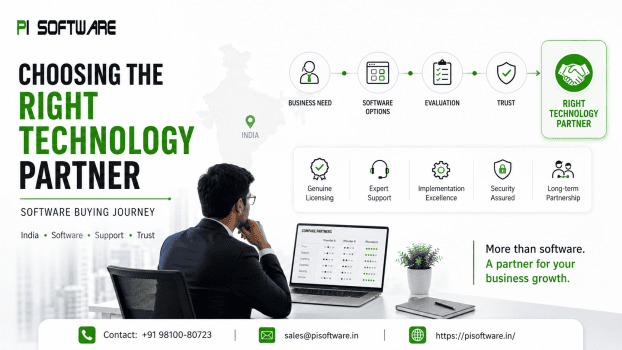
Most software buying mistakes don’t happen at the moment of purchase — they happen months later. When a license doesn’t scale the way the business needs, support is nowhere to be found, or a compliance audit turns up gaps nobody tracked. The actual failure point usually isn’t the product’s choice.
Software procurement today is genuinely more complex than it was a few years ago — more licensing models, more compliance requirements, more vendors to track — and the businesses that navigate it well tend to be the ones treating it as an ongoing relationship, not a one-time purchase decision.
This guide walks through the full enterprise software buying lifecycle, where it typically goes wrong, and what works with an authorized software reseller in India adds beyond the transaction itself.
Why Software Procurement Has Become More Complex
A few shifts have made buying software harder to get right than it used to be:
- Licensing models have multiplied.
- Multi-vendor stacks are now the norm.
- Budget scrutiny has increased.
Common Software Buying Mistakes Businesses Make
- Buying the license tier that “sounds right” instead of mapping actual usage and team size against tier features.
- Skipping requirements evaluation and letting a vendor’s sales pitch define the scope of the purchase.
- Ignoring total cost of ownership — looking only at license price, not implementation, training, and support costs over the license term.
- Treating renewal as automatic rather than a checkpoint to review whether usage still matches the license.
Choosing the Right Licensing Model
- Subscription licensing — lower upfront cost, flexible scaling, well suited to teams with fluctuating headcount or project-based work.
- Team/business licensing — mid-tier options bundling collaboration features for small-to-mid teams.
- Enterprise licensing — volume licensing with centralized management, suited to larger organizations standardizing software across departments.
- Perpetual licensing (where still offered) — higher upfront cost, no recurring fee, but limited or paid upgrade paths — worth evaluating carefully against total cost over the expected use period.
Direct Vendor Purchase vs. Authorized Reseller
| Direct Vendor | Authorized Reseller |
| Generic licensing guidance | Personalized recommendations |
| Separate purchasing for each vendor | Single point of contact for multiple vendors |
| Limited deployment assistance | Deployment and onboarding support |
| Self-managed renewals | Proactive renewal reminders |
| Minimal compliance advice | Licensing and compliance guidance |
| Global support channels | Local support with faster response times |
Software Licensing Compliance
Compliance isn’t just an audit-avoidance exercise — it directly affects operational risk:
- License tracking — knowing exactly what’s licensed, to whom, and under what terms, especially across a multi-vendor stack.
- Software Asset Management (SAM) — a structured practice for tracking deployed software against purchased licenses, reducing both under-licensing risk (compliance) and over-licensing waste (cost).
- Genuine vs. unauthorized software risks — unlicensed or grey-market software carries real exposure: no legitimate support, no compliance protection, and potential legal liability if audited.
Onboarding & Post-Purchase Support
A license that isn’t deployed well doesn’t deliver its value, regardless of how well it was chosen for providing Structured deployment planning, Onboarding and training and Change management, along with Ongoing support access, Proactive renewal planning and License optimization — right-sizing license count and tier over time as team size and usage patterns change, avoiding both under- and over-licensing.
Conclusion:
The businesses that get the most value from their software investments treat procurement as an ongoing practice — clear requirements before purchase, the right licensing model for actual usage, structured deployment, and regular renewal reviews — rather than a one-time buying decision. Working with an authorized reseller doesn’t just simplify the purchase; it extends support and optimization into the months and years after the license is issued, which is where most of the real cost and compliance risk lives.
- Get a Quote for Autodesk, Adobe, Microsoft, SketchUp, or Chaos licensing tailored to your team or Request a Consultation to review your current software, spend and license fit before your next renewal.
Frequently Asked Questions
1. What’s the difference between buying software directly from a vendor and through an authorized reseller?
Direct purchase offers generic, self-service licensing; an authorized reseller provides personalized licensing guidance, multi-vendor procurement in one relationship, deployment support, and proactive renewal management.
2. What is Software Asset Management (SAM) and why does it matter?
SAM is the practice of tracking deployed software against purchased licenses — it reduces both under-licensing compliance risk and over-licensing cost waste.
3. How should we budget software beyond the license price?
Account for implementation, training, and support costs, plus expected renewal price escalation — license price alone significantly understates total cost of ownership.
4. When should we review our software licenses before renewal?
Well before the renewal date — a usage review at that checkpoint often reveals mismatches (over- or under-licensed) that are cheaper to fix before renewal than after.
5. Does PI Software support multiple vendors, or just one?
PI Software is an authorized reseller across Autodesk, Adobe, Microsoft, SketchUp, and Chaos, providing a single point of contact for multi-vendor procurement, licensing, and support.